
Neighborhood
Where to get coffee in downtown Colorado Springs
Four independent coffee shops within walking distance of 217 S. Weber St. Story in Acacia Park, Loyal on South Nevada, Wild Goose on Tejon, and The Perk for the 6 a.m. crowd.
· 6 minRead
Internet options, Zoom upload speeds, coworking backups, altitude and screen fatigue, and time-zone reality for East Coast remote teams.
Downtown Colorado Springs turned into a real remote work destination between 2020 and 2024. Denver overflow drove some of it. So did coastal-city rent. A walkable core with actual coffee, actual gyms, and actual neighbors did the rest. The apartment buildings that came online during those years were built with this kind of resident in mind: decent WiFi wiring, floor plans that fit a desk, and shared amenities you can escape to when the apartment gets small.
Here is what it actually takes to do your day job from here.
Rent is 30 to 40% cheaper than Denver's LoDo or RiNo. It is 60 to 70% cheaper than San Francisco or Brooklyn. You still get a mountain view and real seasons.
The tradeoffs are honest. Fewer local tech employers, so switching jobs while staying in the city is harder. Nightlife is thinner than Denver's. The air is dry enough to surprise anyone coming from anywhere with humidity.
If your employer is remote-first and plans to stay that way, this city holds its own against Boise, Bozeman, and Boulder on any relocation shortlist.
Colorado Springs has better broadband competition than most cities its size. Comcast picked the city as its first DOCSIS 4.0 market in the world, which reshaped what the cable option actually is. Three real choices exist downtown.
Xfinity (Comcast) is ubiquitous. Plans run from 300 Mbps to 2 Gbps download. On DOCSIS 4.0 blocks, the multi-gig X-Class plans are symmetric, so upload matches download. On older DOCSIS 3.1 blocks, upload is asymmetric and lower. Colorado Springs was Comcast's first symmetric multi-gig deployment, so plenty of downtown addresses qualify. It is still block by block.
Quantum Fiber offers fiber where available. Coverage is patchier than Xfinity's, but where it lands you can get 500 Mbps, 940 Mbps, or 2 Gbps symmetric. Quantum's parent Lumen is under acquisition by AT&T as of early 2026, which so far has not disrupted service.
T-Mobile 5G Home Internet fills the gap when neither of the above lands at your unit. Real speeds vary with tower proximity. No contract, no early termination fee. Works as a solid backup, and as a primary connection for a light-workload single-user apartment.
Typical downtown apartment pricing in 2026 runs about $50 to $70 per month for 300 Mbps cable, $70 to $100 for gigabit fiber or symmetric cable, and $50 to $60 for 5G home internet.
Check the FCC broadband map before you sign. Most downtown apartment buildings, Avian included, are wired for multiple providers. Ask which are already provisioned so you can activate service on move-in day.
Download speed is what providers advertise. Upload is what determines whether your video freezes on a call.
Zoom publishes an official bandwidth table. The relevant rows for a working day:
| Use case | Upload minimum |
|---|---|
| Zoom 1:1 HD (720p) | 1.2 Mbps |
| Zoom group HD (720p) | 2.6 Mbps |
| Zoom 1080p group | 3.8 Mbps |
| Uploading a 500 MB file in 5 minutes | around 15 Mbps |
| Screen share plus camera plus streaming reference video | 8 Mbps and up |
Cable plans on a DOCSIS 4.0 block or symmetric fiber both handle any of these without breaking a sweat. Older asymmetric cable, with 10 to 20 Mbps upload on the 300 Mbps tier, will still carry one person on group video reliably. Two people simultaneously on video is where thin upload capacity starts to show. Aim for 20 Mbps of upload if that is your household.
Downtown apartments are efficient. The layout question matters more than the square footage question.
In a studio in the 500 to 700 square foot range, the desk goes against a wall that is not the bed wall. A folding sit-stand rig in a deep closet is a real option if the closet has depth. Some of the studio layouts at Avian include a nook the designers clearly had a home office in mind for.
A one-bedroom, usually 700 to 950 square feet, gives you a proper desk in the living room by a window. The bedroom stays a bedroom. Every so often a floor plan includes a small den or reading nook that fits a real desk with four to six feet of depth.
In a two-bedroom, the second bedroom becomes the office. If both partners work remote, one dedicated office plus a small setup in the living room tends to beat splitting the second bedroom two ways. The person who takes more calls gets the door.
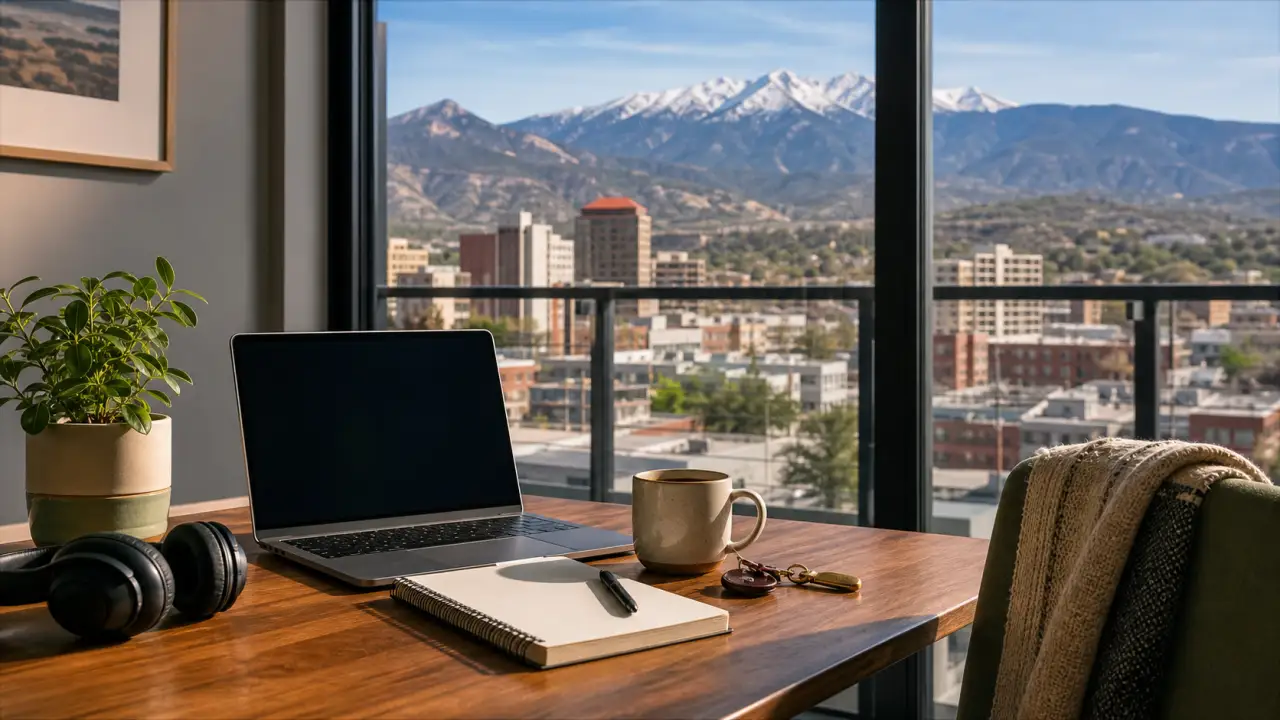
Video call backgrounds matter for some jobs and do not matter at all for others. A bookshelf or a plain wall covers you. On the days when you want to remind people why you moved, a mountain-view balcony behind the laptop is hard to argue with.
Some days the apartment stops working. WiFi gets flaky, a neighbor picks up a hammer drill, or the walls just close in. Downtown has options inside a short walk.
The default is Epicentral Coworking at 415 N Tejon Street, with day passes, dedicated desks, five meeting rooms, an event space, and a smaller satellite on the fifth floor at 13 S Tejon. Longer-term memberships run roughly $150 to $300 per month for a dedicated hot desk, closer to $500 for a private office.
Downtown Penrose Library is the underrated one. Free, quiet enough to think, decent public WiFi, and the study rooms take reservations. A two-hour work session there is basically indistinguishable from a coworking day pass, at $0.
And if you live at Avian, the building's own shared workspace makes the calculus easy. Fastest commute of any option on this list.
The full downtown coffee round-up lives in the coffee guide. Two shops earn their keep as work sessions specifically.
Loyal Coffee at 408 S Nevada Avenue opens at 6 a.m. daily, with fast WiFi and the kind of big communal table that welcomes laptop campers without judgment. Peak is 8 to 11 on weekdays; get there early or bring headphones.
The Best Coffee & Lounge at 401 N Tejon, in the old Wild Goose space, opens at 8 a.m. Outlets everywhere. WiFi holds up under a full room, and they stay open late enough that an afternoon session can slide into a beer without changing venues.
Rules of the road: buy something every 90 minutes, skip the lunch rush, and please do not take a call in the middle of a small cafe. That is how a shop turns off its WiFi for everyone.
Colorado is on Mountain Time, which sits 2 hours behind Eastern Time and 1 hour ahead of Pacific Time. Colorado observes daylight saving on the same schedule as both coasts, so the 2-hour Eastern offset is stable year-round. (Arizona is the outlier on this one.)
What that means in practice for a US-based team:
The 7 a.m. start pattern works better here than in most cities because Colorado Springs is genuinely awake early. Coffee shops open, gyms fill, downtown moves.
Nobody warns you about the eye thing. Colorado Springs sits at about 6,035 feet. Indoor winter humidity commonly drops below 25%. Add six or eight hours a day of screen time and by the end of week two, eyes feel gritty and a low-grade headache shows up somewhere around 3 p.m.
A case-control study of dry eye at altitude found more than twice the prevalence of dry-eye symptoms in a high-altitude cohort compared with sea-level controls. It matches what you actually notice.
The general altitude adjustment guide covers the systemic stuff. Screen-specific tactics for the workday:
Blue-light glasses help some people and do not help others. The humidifier makes a bigger difference than any lens.
Downtown is 90 minutes from Monarch, 20 minutes from the Manitou Incline, 45 minutes from Cripple Creek. There are half a dozen 14ers inside a 90-minute drive. Nobody's willpower survives that indefinitely.
The realistic move is to shift the calendar earlier. Log six focused hours Monday through Thursday plus four hours Friday morning. Put the afternoons outside. The city rewards anyone whose calendar can slide 30% earlier than a standard 9-to-5.
For the remote worker whose employer measures output rather than seat time, this is quietly the best reason to live here.
If you are weighing the move, the cost of living breakdown makes the financial case, and the neighborhood guide covers which block sits closest to the coffee shop and the gym you will actually use.