
Cost of Living
Cost of living in Colorado Springs (2026 breakdown)
Housing, utilities, groceries, transit, healthcare, and taxes in Colorado Springs in 2026 — with rent ranges, salary needs, and a Denver comparison.
· 10 minRead
Rent in Colorado Springs runs about 14.6% lower than Denver. What $1,800 actually gets you in each city, and the tradeoffs averages hide.

Denver has the pull. Bigger job market, denser restaurants, a real airport. Colorado Springs costs less and sits closer to the mountains. The question worth answering is what your rent check actually buys you.
Rent in Colorado Springs runs about 14.6% lower than Denver across unit types, per Numbeo's June 2026 data. You'd need roughly $6,754 a month in Colorado Springs to match a $7,400 Denver lifestyle. Averages hide the tradeoffs you feel month to month. Our full cost-of-living breakdown covers the other line items.
A downtown Denver one-bedroom goes for about $2,060. Outside the city center, the same unit drops to around $1,689. In Colorado Springs, that downtown one-bedroom is roughly $1,770. About $290 less every month. Outside downtown COS, expect $1,516. Over a 12-month lease, that's $3,480.
The gap widens with bigger units. A three-bedroom in downtown Denver averages $3,232. Colorado Springs comes in at $2,625. $607 a month. $7,284 a year.
Median rent in Colorado Springs is $1,648, and Denver's median is $1,831. We track the Colorado Springs side of this comparison quarterly on the downtown rent index, with every major tracker's figure and methodology side by side.
Price-per-square-foot tells a sharper story. Buying in downtown Denver runs $525 per square foot. In downtown Colorado Springs, it's $237. Less than half. Rentals track the same pattern. Your dollar stretches further 70 miles south.
At the top of the Colorado Springs market, a new Class A downtown building like Avian at 217 S. Weber has one-bedroom floor plans from $1,535 to $2,280, with two-bedrooms reaching $2,497 for the highest-floor units. Still below the Denver downtown average, with new construction, rooftop amenities, LEED Silver certification.
Space, obviously. The less obvious answer is newer space.
Downtown Denver's rental stock skews older. There are shiny new builds in RiNo and LoDo, but most come with Denver pricing attached. A one-bedroom in a 2023 build with a gym and rooftop will land closer to $2,400. The same $2,400 in Colorado Springs gets you a top-floor two-bedroom in a building that opened in the last three years, with a pool, spa, and mountain views from the gym.
Colorado Springs has been adding supply steadily for five years. Because land costs less, developers can build amenity stacks that wouldn't pencil out at Denver land prices. Rooftop pools. Sky decks. Yoga studios. Pet spas. The stuff that used to read "Denver luxury only" is now standard in new downtown COS buildings.
There's a catch. Colorado Springs is smaller. Restaurant density is lower. Concert tours skip it. Want IKEA or a nonstop international flight? You're driving north.
Denver has the bigger job market. Tech (Google, Slack, Gusto), finance (Charles Schwab, TIAA), aerospace (Lockheed Martin, Sierra Space), and healthcare (HealthONE, UCHealth) all have headquarters or major campuses in the Denver metro.
Colorado Springs runs on a different mix. Five military installations (Fort Carson, Peterson Space Force Base, Schriever Space Force Base, NORAD/NORTHCOM, and the Air Force Academy) anchor an economy heavy on defense contracting, cybersecurity, and aerospace. The U.S. Olympic & Paralympic Museum, which opened in 2020, added a tourism layer. UCHealth Memorial and Penrose-St. Francis are large downtown employers.
Average monthly net salary in Denver: $4,487. In Colorado Springs: $4,245. About 5.4% lower. Local purchasing power in Colorado Springs is 3.7% higher after adjusting for costs. You earn less and keep more.
Remote workers change the math. If your salary doesn't move based on where you live, the Colorado Springs discount is pure savings. The cohort is growing. Defense contractors on hybrid schedules. Tech workers who fly out of DEN twice a month. Healthcare professionals who can pick their hospital system.
Denver punches above its weight. A real downtown skyline. Five professional sports teams. A light rail system. Neighborhoods with distinct identities like Baker, Wash Park, RiNo, Highlands. Traffic on I-25 and I-70 is real. You'll sit in it.
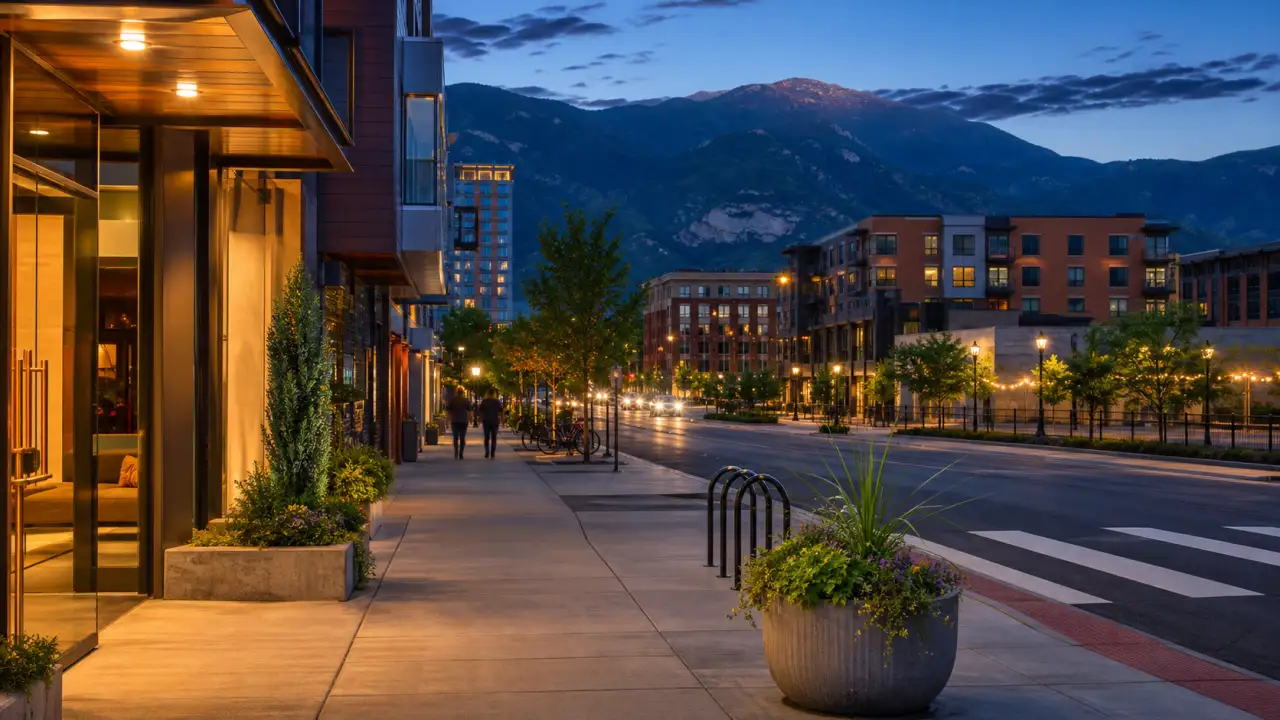
Colorado Springs is a 488,000-person city that still behaves like a large town in places. It sprawls. Most people drive. The downtown core (roughly Weber to Cascade, Colorado to Cimarron) is walkable and has picked up speed in the last five years with new bars, restaurants, and apartments. Beyond that core, you're in suburban grid. The downtown neighborhood guide goes deeper.
Outdoor access tilts toward Colorado Springs. Garden of the Gods is inside city limits. Pikes Peak is 30 minutes from downtown. The Broadmoor's hiking trails, Cheyenne Mountain State Park, and the Manitou Incline are all within a 20-minute drive. Denver has proximity to the mountains too, but on a Saturday morning, you're sharing I-70 with half the metro area.
Both cities get about 300 days of sunshine a year. Colorado Springs sits at 6,035 feet. Denver at 5,280, its "Mile High" namesake. Winters look similar. Cold snaps followed by 55-degree afternoons that melt everything by Tuesday.
Outside of rent, Colorado Springs still wins. Groceries are 9.4% cheaper. A mid-range dinner for two runs about $85 in COS versus $95 in Denver. Monthly transit pass: $63 instead of $88. Gym memberships: $62 versus $71.
Yes. People do it. About 70 miles on I-25 separate the two downtowns. Roughly an hour and ten minutes without traffic, and anywhere from 90 minutes to two hours during rush hour.
The math works if you're commuting two or three days a week instead of five. Say you save $400 a month on rent by living in Colorado Springs. Three days a week is roughly 12 round-trips a month. At 2.5 hours of driving per round-trip, that's 30 hours a month in the car. $400 divided by 30 is about $13.33 an hour. You're paying yourself that to drive.
Some people find the tradeoff worth it. Most don't.
The ones who make it work tend to be couples where one person works in Denver and the other in Colorado Springs (they split the difference and live in Monument or Castle Rock), defense contractors with a single weekly Denver office day, and remote workers who go in for quarterly meetings. If you're driving down I-25 five days a week to a downtown Denver office, the corridor will eat the rent savings in gas, car maintenance, and time.
Pick Denver if: you want the biggest job market in the Mountain West, you care about having 30+ neighborhoods to choose from, you fly often (DEN is a major hub), you want a light rail system, or you're in your 20s and want maximum social density.
Pick Colorado Springs if: you'd rather have a nicer apartment than a longer resume of nearby bars, you work in defense, aerospace, or healthcare, you're remote and location-independent, you want to be closer to the mountains without the I-70 traffic, or you're priced out of the Denver neighborhood you actually want.
A third option gets overlooked. Colorado Springs for two to three years, then Denver. Use the lower rent to build savings or pay down debt while still living in a city with real amenities and a downtown. Denver isn't going anywhere. Moving north in 2028 with an extra $15,000 in the bank is a position most Denver renters don't have.
Depends on what you want your Tuesday to look like. If you want to walk to a coffee shop, work from a downtown apartment with mountain views, hit a rooftop pool after 5 p.m., and be on a trail by 7 a.m. on Saturday, Colorado Springs delivers at a price that doesn't require a Denver tech salary.
Population is roughly 488,000, Colorado's second-largest city. It's been growing steadily, at a slower clip than Austin or Boise, but reliably.
Active. Downtown has added several new Class A buildings in the last three years, and lease-up concessions are common. At Avian, a LEED Silver building at 217 S. Weber, the current promotion is up to 10 weeks of free rent plus six months of free parking, restrictions apply. One-bedrooms start at $1,535 and run up to $2,280 for the largest floor plan. Two-bedrooms are $2,295 to $2,497.
Those numbers track the broader Colorado Springs market. You're paying 15 to 20% less than an equivalent Denver unit while getting newer construction and comparable amenities. The catch is you're in Colorado Springs, not Denver. Whether that's a catch or a feature depends on which city you actually want to wake up in.
Data sources: Numbeo cost-of-living comparison (updated June 5, 2026), Niche.com Colorado Springs overview, Niche.com Denver overview. Rent figures reflect June 2026 user-contributed averages and may vary by neighborhood, unit type, and lease terms. Wikipedia data for Colorado Springs geography and distance; Britannica for Denver elevation.
Touring Colorado Springs? Avian's floor plans and amenity list are online. Schedule a tour to walk the building.