Neighborhood
The best restaurants within walking distance of downtown Colorado Springs
Nine restaurants worth knowing within a 10-minute walk of 217 S. Weber St., from a 1901-built brewpub to a rooftop social bar.
· 5 minRead
Colorado Springs has 7 distinct neighborhoods with very different vibes, price points, and commute profiles. Here's what each is actually like before you sign.
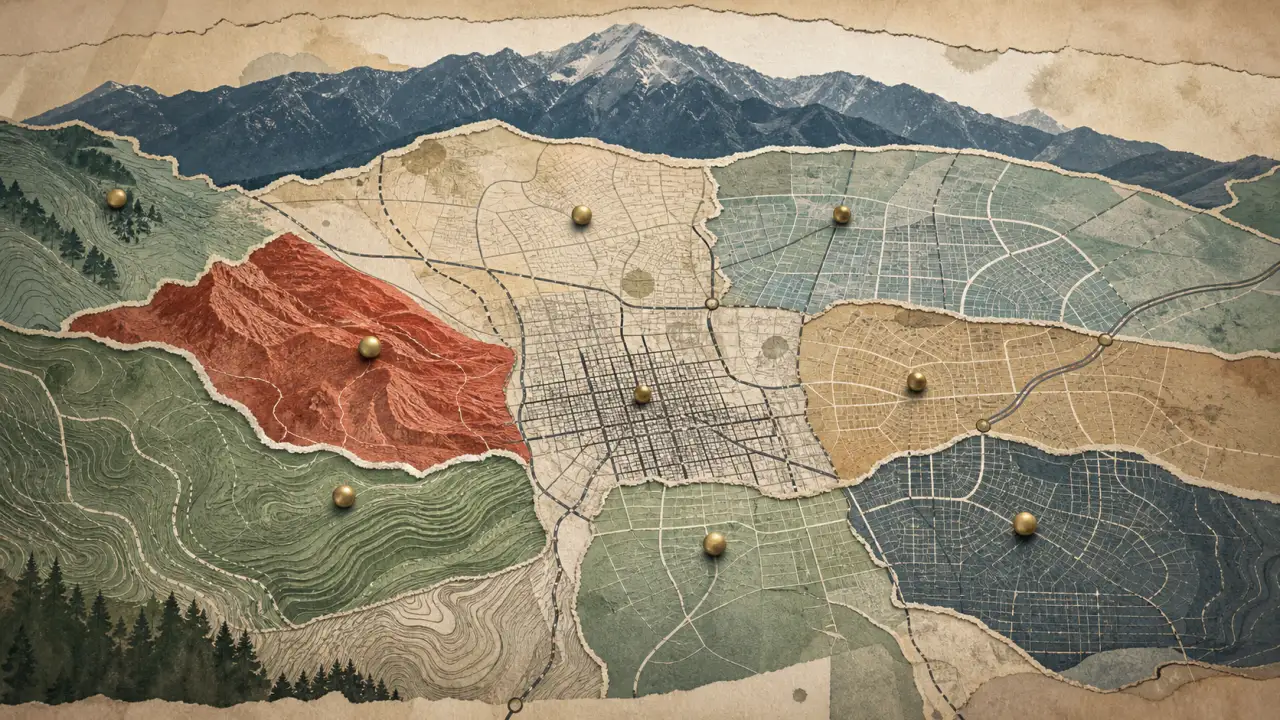
Nearly 500,000 people live inside the city. Another 250,000 in the metro. About 50 zip codes. Pick the wrong one and you'll spend 35 minutes driving to dinner. Pick the right one and you can walk to Pikes Peak views, a good restaurant, and your gym without touching your car.
Here are the seven areas where most newcomers actually land.
It's a horizontal city. Downtown is small and walkable. Everywhere else, you need a car.
The city runs about 35 miles north to south along I-25, so where you work matters. A job at Peterson Space Force Base and a job at UCHealth Memorial downtown are 25 miles apart. That's a real distinction.
Colorado Springs isn't Denver. Median rents run about 20% lower, and the broader cost gap works out to roughly 8.7% across rent, utilities, and groceries. The downtown core is genuinely walkable by Colorado standards, not Chicago standards, but real sidewalks and real density. Mountain views are real from most of town, not just the photos.
Military presence shapes the whole city. Five installations (Fort Carson, Peterson SFB, Schriever SFB, NORAD/NORTHCOM, and the Air Force Academy) mean a big chunk of residents are active-duty, veterans, or defense contractors. That changes traffic, school enrollment, and the rental market. If you're PCSing to Colorado Springs, the off-base apartment playbook covers BAH, house-hunting leave, and commute times from downtown to each installation.
Almost everyone underestimates the altitude. Colorado Springs sits at 6,035 feet, and the first two weeks feel different whether you're moving from Chicago or Denver.
Roughly bounded by Platte to the north, Cimarron to the south, Nevada to the east, 8th Street to the west. The walkable core is about ten blocks square.
Small by coastal-city standards. And the only part of Colorado Springs where you can realistically go car-free.
Monument Valley Park is a short walk from most addresses. Tejon Street has restaurants and bars within half a mile of each other. The U.S. Olympic & Paralympic Museum opened in July 2020 and pulled new retail and restaurants to the west end that weren't there five years ago. The before-and-after is still happening.
Who lives here: professionals without kids, remote workers from Denver or the coasts, military officers who don't want to live on base, UCHealth staff at the Memorial Hospital campus. Skews 25 to 45, college-educated, active.
One-bedrooms in newer downtown buildings go $1,500 to $2,200 depending on floor, finishes, and view. A fraction of what comparable units cost in Denver's LoDo or RiNo. Two-bedrooms run $2,300 to $3,500 at the top of the new Class A market.
Parking is the tradeoff. Most new buildings have covered garages, but street parking gets tight near Tejon on weekends. Buildings with included garage spots (which most new downtown construction offers) take that off the table.
Two miles west of downtown along Colorado Avenue. Founded in 1859, it's the oldest neighborhood in the city and predates the city itself by 12 years. The surviving commercial strip is pure 1880s and 1890s. Red brick storefronts, independent galleries, wine bars, brunch spots that have been there since before brunch was a thing.
Housing is mostly older single-family homes and a few small apartment buildings. No new Class A construction. You get more space per dollar than downtown, a quieter street, and a neighborhood that's been stable for decades.
Commute to downtown: 10 minutes by car. 25 by bike along the Monument Valley Park path. Not bad.
Downsides: limited new supply, aging building stock, not much nightlife past 10pm.
If you're coming from a real city and the word "Briargate" makes you nervous, look here.
The Old North End is the grid of historic bungalows and Victorians north of downtown, between Uintah and Fillmore. Ivywild is the pocket neighborhood south of downtown, centered on the Ivywild School. A converted elementary school that now holds a brewery, coffee shop, barbershop, and bakery all in one building.
Both have the bones of a real neighborhood. Old trees, sidewalks, front porches, shops you can walk to. The Old North End has some of the priciest single-family homes in the city. Ivywild is more mixed-income and gentrifying fast.
If you're renting, options are limited and turn over slowly. Most landlords here are small individual owners, not professional management companies. So you get more flexibility or more unpredictability, depending on your luck.
A planned residential community in north Colorado Springs, built mostly between 1980 and 2010. Where a lot of families end up.
The case for it: good public schools (District 20 is consistently one of the higher-rated districts in the state), newer construction, easy access to Chapel Hills Mall, short drive to the Air Force Academy. If you have school-age kids, a car, and no strong preference for walkability, it works.
The case against, if you're weighing it against downtown: there's no there there. You drive to everything. Restaurants are chain-heavy. The look is strip malls and roundabouts.
That's not a knock. It's just the accurate description.
Rents run $1,400 to $2,100 for a one-bedroom in a newer complex. Competitive with downtown on the raw number, without the urban amenities.
Powers Boulevard runs north-south along the eastern edge of the city. The neighborhoods around it (Stetson Hills, Norwood, Indigo Ranch) are heavily military-family territory. Peterson Space Force Base is right there. Schriever SFB is another 15 minutes east on Highway 94.
If you're active duty or a contractor at either base, this is the most convenient address in the city. Ten minutes from work. Fifteen from a grocery store.
The trade is almost everything else. Downtown is 25 to 30 minutes in traffic. The Broadmoor is 40.
Powers is affordable. One-bedrooms start around $1,100 in older complexes. You're in the suburbs by every measure. That's fine as long as you know it going in.
Technically its own municipality, not part of Colorado Springs at all. Sits at the base of Pikes Peak, about eight miles west of downtown.
Population around 5,000. One of the most distinct identities on the entire Front Range. Mineral springs, independent shops, the Incline (a brutal 2,768-step climb gaining nearly 2,000 feet in under a mile), and a community that skews artist and outdoor-enthusiast. No chains on Manitou Avenue. Property values have climbed sharply over the past decade as Denver transplants found it.
Commute to downtown Colorado Springs is 20 minutes in regular traffic. Longer on weekends when tourist season runs, and it runs long here.
So not for anyone who wants downtown convenience. But if you want mountains in your backyard and a small-town feel with actual character, there's nowhere quite like it on the Front Range.
The old-money neighborhood in the southwest corner of the city, built around the Broadmoor Hotel, a five-star resort that's been running since its grand opening on June 29, 1918. The residential areas nearby have large lots, mountain views, and proximity to Cheyenne Mountain State Park.
Mostly owner-occupied single-family. Rental inventory is thin. Prices are high. Downtown is 20 minutes south, the airport is 25 minutes northeast, and there's no walkable retail to speak of.
For the right buyer, that trade makes sense. For anyone who wants walkable daily life, it doesn't.
(The hotel is worth a visit regardless of where you live. It's one of the better resort properties in the state.)
Stetson Hills is a master-planned development in the northeast. Falcon is even further out, east of Peterson along Woodmen Road and Highway 24. Both have seen heavy new construction since 2015.
Prices are lower than downtown or Briargate, and the homes are newer. But you're 30 to 40 minutes from downtown with minimal walkable infrastructure.
These areas make sense for families who want new construction at a lower price and don't care much about urban access.
Downtown costs more per square foot. True. A 750 sq ft one-bedroom in a new downtown building runs $1,700 to $2,100. The same square footage in Briargate or Powers runs $1,400 to $1,700.
But the math shifts once you add parking (free or included in most new downtown buildings), car usage (a downtown resident who walks to work, groceries, and restaurants logs far fewer miles and less wear), and gym memberships (newer downtown buildings include fitness centers, yoga studios, pools, and spa access that would otherwise run $50 to $150 a month).
The real gap is often $100 to $200 a month once you add it up. Not the $300 to $400 the raw rent suggests.
Is Colorado Springs a good place to move in 2026? Yes. The metro unemployment rate has stayed at or below 4% for most of the last three years. Population growth averaged about 1.5% annually through 2019 and has slowed since the pandemic, but the fundamentals haven't changed. Housing costs run about 20% lower than Denver, and the job market is anchored by five military installations and a growing healthcare sector.
Best neighborhood for young professionals? Downtown, without much competition. Highest concentration of walkable restaurants, bars, and cultural venues, the newest apartment stock, and best access to UCHealth Memorial, city and county government, and the growing remote-work crowd. Old North End and Ivywild are solid alternatives if you want a house with more character and can handle limited rental inventory.
Is downtown Colorado Springs safe? Relative to other cities its size, yes. Downtown has seen sustained investment and increased foot traffic since the Olympic Museum opened in 2020. Like any urban core, some blocks are more active than others after midnight. The residential streets around S. Weber St. and the Monument Valley Park corridor are quiet and well-lit. New Class A buildings have controlled access and covered parking.
Commute from downtown to Fort Carson or the Air Force Academy? Fort Carson is 20 to 25 minutes south on I-25, depending on traffic. The Air Force Academy is about 20 minutes north. Both are manageable daily drives. For Peterson and Schriever SFBs, plan on 25 to 30 minutes east. Doable for officers who want an urban home base, but not ideal.
Real difference between Colorado Springs and Denver? About 70 miles and $600 a month on rent. Colorado Springs has fewer tech companies, less nightlife, and a more conservative political culture. It also has lower costs, shorter commutes inside the city, better mountain access from the core, and a sense of scale that's easier to live in. A lot of Denver transplants who moved here say they didn't expect to like it as much as they do.
Newest apartment building in downtown Colorado Springs? Avian at 217 S. Weber St. is among the newest Class A buildings downtown. LEED Silver certified, studios through two-bedrooms starting at $1,535, with a rooftop spa, fitness center with mountain views, pool, and covered parking garage.
Touring downtown apartments? Avian is a LEED Silver certified apartment community at 217 S. Weber St. in downtown Colorado Springs. Floor plans start at $1,535, with a rooftop spa, fitness center, and covered parking. Schedule a tour to walk the building and see the views in person.